Core Assessment Vocabulary
Release: 30/01/2026
- This version:
- http://data.europa.eu/2sa/cav#
- Latest version:
- http://data.europa.eu/2sa/cav#
- Revision:
- 1.4.0
- Issued on:
- 30/01/2026
- See also:
- https://github.com/isa-camss/CAV
- https://joinup.ec.europa.eu/collection/common-assessment-method-standards-and-specifications-camss/solution/core-assessment-vocabulary-cav
- Download serialization:

- License:

- Cite as:
- Core Assessment Vocabulary. Revision: 1.4.0. Retrieved from: http://data.europa.eu/2sa/cav#
Abstract
CAV represents and defines what an “Assessment” of “assets” is and how to perform the assessment based on “Criteria”. It is a domain-agnostic vocabulary, meaning that it can be used to assess any type of assets. It is a European Commission solution.Introduction back to ToC
The Core Assessment Vocabulary represents, expresses, and defines what an “Assessment” of “Assets” is and how to perform the assessment based on “Criteria”. It is a domain-agnostic vocabulary, meaning that it can be used to assess any asset. The CAV addresses semantic interoperability by reusing existing generic ontologies and vocabularies. This way, the semantics of common concepts and properties are agreed without having to re-discuss them. When concepts or properties have not been identified nor defined for the purposes pursued, they have to be proposed either as extensions or from scratch.
The methodological approach followed for the development of the CAV reuses the following ontologies and vocabularies:
- Data Catalogue Vocabulary (DCAT)
- Friend of a Friend (FOAF)
- Asset Description Metadata Schema (ADMS)
- The Organization Ontology
- Core Criterion and Core Evidence Vocabulary (CCCEV)
- DCMI Metadata Terms (DCTerms)
- Schema
Namespace declarations
| adms | <http://www.w3.org/ns/adms#> |
| cav | <http://data.europa.eu/2sa/cav#> |
| cc | <http://creativecommons.org/ns#> |
| cv | <https://data.europa.eu/m8g/> |
| dc | <http://www.omg.org/spec/UML/20131001/UMLDC> |
| dcat | <http://www.w3.org/ns/dcat#> |
| dct | <http://purl.org/dc/terms/> |
| foaf | <http://xmlns.com/foaf/0.1/> |
| org | <http://www.w3.org/ns/org#> |
| owl | <http://www.w3.org/2002/07/owl#> |
| rdf | <http://www.w3.org/1999/02/22-rdf-syntax-ns#> |
| rdfs | <http://www.w3.org/2000/01/rdf-schema#> |
| sch | <https://schema.org/> |
| skos | <http://www.w3.org/2004/02/skos/core#> |
| vann | <http://purl.org/vocab/vann/> |
| xml | <http://www.w3.org/XML/1998/namespace> |
| xsd | <http://www.w3.org/2001/XMLSchema#> |
Core Assessment Vocabulary: Overview back to ToC
This ontology has the following classes and properties.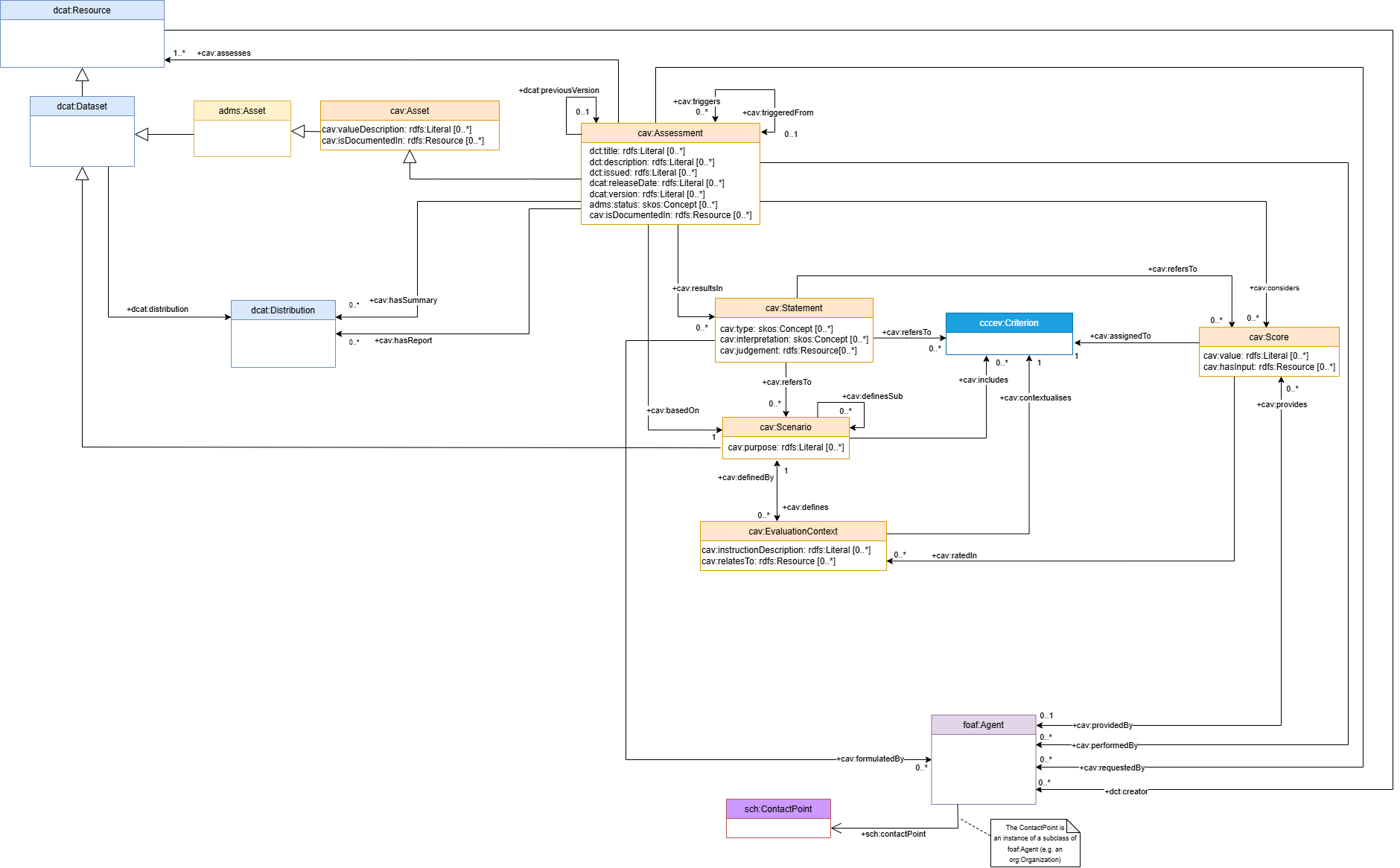
Classes
Object Properties
- Assesses
- Assigned to
- Based on
- Considers
- Contact point
- Based on
- Contextualises
- Defined by
- Defines
- Defines sub
- distribution
- Documented in
- Formulated by
- Has input
- Has report
- Has summary
- Includes
- Performed by
- Previous version
- Provided by
- Provides score
- Rated in
- Refers to
- Relates to
- Requested by
- Results in
- Triggered from
- Triggers
Data Properties
Core Assessment Vocabulary: Description back to ToC
A CAV Assessment is a specialisation of an Asset, which is itself also a specialisation of the dcat:Dataset and by extension of dcat:Resource.
RDFS(RDF Schema) provides a basic vocabulary for defining classes and properties of a resource. Within this framework, an rdfs:Resource represents the most general concept, capable of describing anything.
CAV, however, needs to clearly delimit which resources are subject to assessment, and it does so by relying on widely accepted standards. DCAT builds on the abstract notion of a resource and makes it operational for data catalogues. Since the subject of an assessment is intended to be a dataset or a service, a cav:Assessment assesses a dcat:Resource.
In parallel, ADMS adopts a more general perspective, allowing an rdfs:Resource to describe its own content; in this case, the resource is implicitly represented as an adms:Asset. Because an adms:Asset can be catalogued —and is therefore considered a dcat:Dataset, and because a cav:Assessment is itself meant to be catalogued, it follows logically that any assessment of a resource becomes an asset. This ensures full alignment with the ADMS specification.
This alignment is important because CAV assessments are published in catalogues like the Interoperable Europe Portal. Using adms:Asset helps CAV avoid repeating existing concepts, keeps the vocabulary consistent, and makes it easier to connect with other frameworks. As a result, CAV assets will be preserved on the basis of documenting and making them compatible with CCCEV.
As any ADMS Asset, the Assessment can be identified and described, and has individuals’ distributions, publishers, etc. Additionally to these properties the CAV class Assessment needs to specify who are the requestors and evaluators of the Assessments. These can be anything represented by a FOAF Agent, such as a natural person, a group or an organisation. Notice that the objects assessed are also Resources meaning that the CAV may be used to assess anything that is considered a valuable resource . Example of such resources could be products, services, or, in the case of CAMSS, standards and specifications.
An Assessment results in Statements capturing the produced knowledge and providing value judgments. These can refer to the Assessment as a whole or a specific section, even being as detailed as to refer to individual evaluated criteria.
A Criterion is typically derived from a Reference Framework, which is to be understood as a series of “agreed and descriptive reference requirements” coming from one or more sources (e.g., legislation, specifications and standards, ICT policy-related works like the EIF within the EIS, etc.). Throughout the Assessment each Criterion is assigned a Score (in principle by humans, but potentially also by systems) as the value output that is considered when formulating the resulting Statement(s). The Score can take into consideration any resource input (e.g., when the score is calculated based on different input parameters, algorithms, and formulae).
Any Assessment is performed in the context of a Scenario. The Scenario defines the purpose of the Assessment and the set of Criteria to be scored by one or more Agents. Scenarios can be defined with a flexible structure including nested sections (represented as sub-Scenarios) that serve to provide additional context, group thematically Criteria and be referred to by the assessment’s resulting Statement(s). Criteria can themselves be simple or complex and originate from various reference sources. The overall context for the evaluation of the Criteria is provided by the Scenario, however in case certain Criteria require additional contextualisation or evaluation instructions these can exceptionally be provided by means of Evaluation Context which is related to a resource . Moreover, an Assessment might trigger another related Assessment of different content which has its own Scenario and Criteria. Finally, an Assessment has a title and a description to facilitate the identification of the Asset. Note that it is also possible to model work in progress, expressed by having the Assessment defining optional links to Scores, Statements, reports and summaries. The versioning of an Assessment is represented by the version datatype property of DCAT to keep track of the current version of the Assessment and its relationship with a previous one; setting up the issued date (assessment performance date) and the release date (assessment publication date) of the Assessment is also recommended, where the CAV reuses the DCTerms issued (date) property for both.
Cross-reference for Core Assessment Vocabulary classes, object properties and data properties back to ToC
This section provides details for each class and property defined by Core Assessment Vocabulary.Classes
Assessmentc back to ToC or Class ToC
IRI: http://data.europa.eu/2sa/cav#Assessment
- has super-classes
- Asset c
- is in domain of
- Assesses op, Considers op, Based on op, Description dp, Documented in op, Has report op, Has summary op, Issued dp, Performed by op, Previous version op, Release date dp, Requested by op, Results in op, Status dp, Title dp, Triggered from op, Triggers op, Version dp
- is in range of
- Previous version op, Triggered from op, Triggers op
Assetc back to ToC or Class ToC
IRI: http://data.europa.eu/2sa/cav#Asset
- has super-classes
- Asset c
- has sub-classes
- Assessment c
- is in domain of
- Documented in op, Value description dp
Datasetc back to ToC or Class ToC
IRI: http://www.w3.org/ns/dcat#Dataset
- has super-classes
- Resource c
- has sub-classes
- Asset c, Scenario c
- is in domain of
- distribution op
- is disjoint with
- Scenario c
Evaluation contextc back to ToC or Class ToC
IRI: http://data.europa.eu/2sa/cav#EvaluationContext
- is in domain of
- Contextualises op, Defined by op, Instruction description dp, Relates to op
- is in range of
- Rated in op, Defines op
Scenarioc back to ToC or Class ToC
IRI: http://data.europa.eu/2sa/cav#Scenario
- has super-classes
- Dataset c
- is in domain of
- Defines op, Defines sub op, Includes op, Purpose dp
- is in range of
- Based on op, Defined by op, Defines sub op, Refers to op
- Defined by op, Defines sub op, Refers to op
- is disjoint with
- Dataset c
Scorec back to ToC or Class ToC
IRI: http://data.europa.eu/2sa/cav#Score
- is in domain of
- Assigned to op, Based on op, Has input op, Provided by op, Value dp
- is in range of
- Considers op, Provides score op, Refers to op
Statementc back to ToC or Class ToC
IRI: http://data.europa.eu/2sa/cav#Statement
- is in domain of
- Formulated by op, Interpretation dp, Judgement dp, Refers to op, Type dp
- is in range of
- Results in op
Object Properties
- Assesses
- Assigned to
- Rated in
- Considers
- Contact point
- Based on
- Contextualises
- Defined by
- Defines
- Defines sub
- distribution
- Documented in
- Formulated by
- Has input
- Has report
- Has summary
- Includes
- Performed by
- Previous version
- Provided by
- Provides score
- Rated in
- Refers to
- Relates to
- Requested by
- Results in
- Triggered from
- Triggers
Assessesop back to ToC or Object Property ToC
IRI: http://data.europa.eu/2sa/cav#assesses
- has domain
- Assessment c
- has range
- Resource c
Assigned toop back to ToC or Object Property ToC
IRI: http://data.europa.eu/2sa/cav#assignedTo
Based onop back to ToC or Object Property ToC
IRI: http://data.europa.eu/2sa/cav#ratedIn
- has domain
- Score c
- has range
- Evaluation context c
Considersop back to ToC or Object Property ToC
IRI: http://data.europa.eu/2sa/cav#considers
- has domain
- Assessment c
- has range
- Score c
Contact pointop back to ToC or Object Property ToC
IRI: https://schema.org/contactPoint
- has domain
- Agent c
- has range
- Contact Point c
Based onop back to ToC or Object Property ToC
IRI: http://data.europa.eu/2sa/cav#basedOn
- has domain
- Assessment c
- has range
- Scenario c
Contextualisesop back to ToC or Object Property ToC
IRI: http://data.europa.eu/2sa/cav#contextualises
- has domain
- Evaluation context c
- has range
- Criterion c
Defined byop back to ToC or Object Property ToC
IRI: http://data.europa.eu/2sa/cav#definedBy
- has domain
- Evaluation context c
- has range
- Scenario c
- is inverse of
- Defines op
Definesop back to ToC or Object Property ToC
IRI: http://data.europa.eu/2sa/cav#defines
- has domain
- Scenario c
- has range
- Evaluation context c
- is inverse of
- Defined by op
Defines subop back to ToC or Object Property ToC
IRI: http://data.europa.eu/2sa/cav#definesSub
distributionop back to ToC or Object Property ToC
IRI: http://www.w3.org/ns/dcat#distribution
- has sub-properties
- Has report op, Has summary op
- has domain
- Dataset c
- has range
- Distribution c
Documented inop back to ToC or Object Property ToC
IRI: http://data.europa.eu/2sa/cav#documentedIn
- has domain
- Assessment c
- Asset c
- has range
- Resource c
Formulated byop back to ToC or Object Property ToC
IRI: http://data.europa.eu/2sa/cav#formulatedBy
Has inputop back to ToC or Object Property ToC
IRI: http://data.europa.eu/2sa/cav#hasInput
Has reportop back to ToC or Object Property ToC
IRI: http://data.europa.eu/2sa/cav#hasReport
- has super-properties
- distribution op
- has domain
- Assessment c
- has range
- Distribution c
Has summaryop back to ToC or Object Property ToC
IRI: http://data.europa.eu/2sa/cav#hasSummary
- has super-properties
- distribution op
- has domain
- Assessment c
- has range
- Distribution c
Includesop back to ToC or Object Property ToC
IRI: http://data.europa.eu/2sa/cav#includes
Performed byop back to ToC or Object Property ToC
IRI: http://data.europa.eu/2sa/cav#performedBy
- has domain
- Assessment c
- has range
- Agent c
Previous versionop back to ToC or Object Property ToC
IRI: http://www.w3.org/ns/dcat#previousVersion
- Is defined by
- https://www.w3.org/ns/dcat#
- has domain
- Assessment c
- has range
- Assessment c
Provided byop back to ToC or Object Property ToC
IRI: http://data.europa.eu/2sa/cav#providedBy
- has domain
- Score c
- has range
- Agent c
- is inverse of
- Provides score op
Providesop back to ToC or Object Property ToC
IRI: http://data.europa.eu/2sa/cav#provides
- has domain
- Agent c
- has range
- Score c
- is inverse of
- Provided by op
Rated inop back to ToC or Object Property ToC
IRI: http://data.europa.eu/2sa/cav#ratedIn
Refers toop back to ToC or Object Property ToC
IRI: http://data.europa.eu/2sa/cav#refersTo
Relates toop back to ToC or Object Property ToC
IRI: http://data.europa.eu/2sa/cav#relatesTo
- has domain
- Evaluation context c
- has range
- Resource c
Requested byop back to ToC or Object Property ToC
IRI: http://data.europa.eu/2sa/cav#requestedBy
- has domain
- Assessment c
- has range
- Agent c
Results inop back to ToC or Object Property ToC
IRI: http://data.europa.eu/2sa/cav#resultsIn
- has domain
- Assessment c
- has range
- Statement c
Triggered fromop back to ToC or Object Property ToC
IRI: http://data.europa.eu/2sa/cav#triggeredFrom
- has domain
- Assessment c
- has range
- Assessment c
- is inverse of
- Triggers op
Triggersop back to ToC or Object Property ToC
IRI: http://data.europa.eu/2sa/cav#triggers
- has domain
- Assessment c
- has range
- Assessment c
- is inverse of
- Triggered from op
Data Properties
- Description
- Instruction description
- Interpretation
- Issued
- Judgement
- Purpose
- Release date
- Status
- Title
- Type
- Value
- Value description
- Version
Descriptiondp back to ToC or Datatype Property ToC
IRI: http://purl.org/dc/terms/description
- has domain
- Assessment c
- has range
- Literal
Instruction descriptiondp back to ToC or Datatype Property ToC
IRI: http://data.europa.eu/2sa/cav#instructionDescription
- has domain
- Evaluation context c
- has range
- Literal
Interpretationdp back to ToC or Datatype Property ToC
IRI: http://data.europa.eu/2sa/cav#interpretation
Issueddp back to ToC or Datatype Property ToC
IRI: http://purl.org/dc/terms/issued
- has sub-properties
- Release date dp
- has domain
- Assessment c
- has range
- Resource
Judgementdp back to ToC or Datatype Property ToC
IRI: http://data.europa.eu/2sa/cav#judgement
Purposedp back to ToC or Datatype Property ToC
IRI: http://data.europa.eu/2sa/cav#purpose
Release datedp back to ToC or Datatype Property ToC
IRI: http://www.w3.org/ns/dcat#releaseDate
- has super-properties
- Issued dp
- has domain
- Assessment c
- has range
- Literal
Statusdp back to ToC or Datatype Property ToC
IRI: http://www.w3.org/ns/adms#status
- Is defined by
- http://www.w3.org/ns/adms#
- has domain
- Assessment c
- has range
- Concept ep
Titledp back to ToC or Datatype Property ToC
IRI: http://purl.org/dc/terms/title
- has domain
- Assessment c
- has range
- Literal
Typedp back to ToC or Datatype Property ToC
IRI: http://data.europa.eu/2sa/cav#type
Valuedp back to ToC or Datatype Property ToC
IRI: http://data.europa.eu/2sa/cav#value
Value descriptiondp back to ToC or Datatype Property ToC
IRI: http://data.europa.eu/2sa/cav#valueDescription
Versiondp back to ToC or Datatype Property ToC
IRI: http://www.w3.org/ns/dcat#version
- Is defined by
- http://www.w3.org/ns/dcat#
- has domain
- Assessment c
- has range
- Literal
Legend back to ToC
op: Object Properties
dp: Data Properties
ep: External Properties
References back to ToC
Add your references here. It is recommended to have them as a list.Acknowledgments back to ToC
The authors would like to thank Silvio Peroni for developing LODE, a Live OWL Documentation Environment, which is used for representing the Cross Referencing Section of this document and Daniel Garijo for developing Widoco, the program used to create the template used in this documentation.